The St. Valentine’s Day Massacre: Chicago 1929 EP# 0011

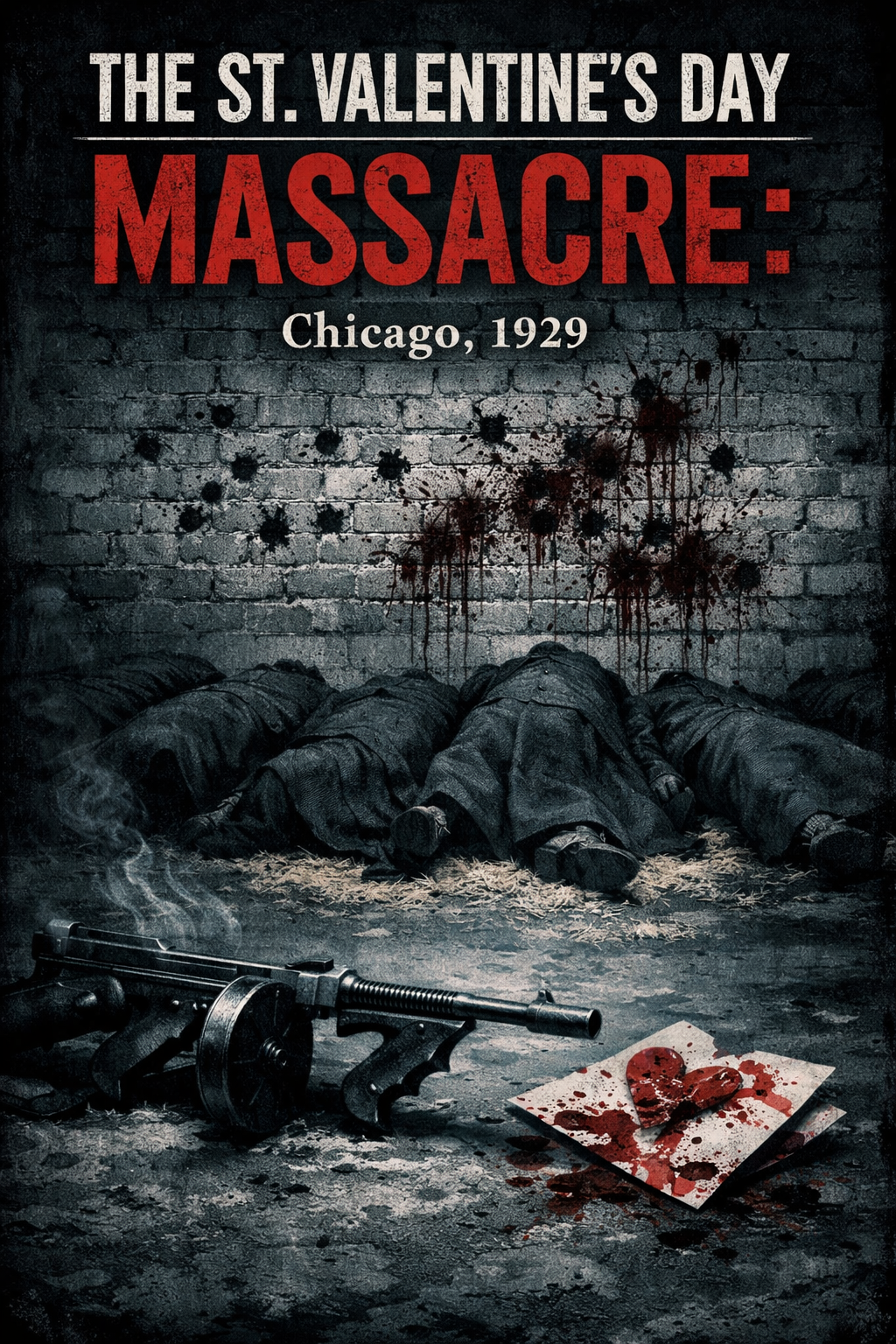
On the morning of February 14, 1929, Chicago was locked in ice. Snow lay in filthy gray drifts along Clark Street on the city’s North Side, hardened by weeks of cold and neglect. Inside a brick garage at 2122 North Clark Street, seven men waited in the bitter air, stamping their feet and rubbing their hands together. They believed they were about to make the biggest liquor deal of their lives. Instead, they were waiting to be executed.
Chicago in the late 1920s was not ruled by law. It was ruled by bootleggers. Prohibition had transformed alcohol into liquid gold and turned the city into a battlefield. Two men stood above all others. On the South Side was Alphonse “Al” Capone, a brilliant and ruthless empire builder whose breweries, distilleries, and speakeasies stretched across Chicago. On the North Side was George “Bugs” Moran, the last major crime boss standing in Capone’s way.
Their rivalry was about far more than booze. It was about territory, power, and control of the city itself. By early 1929, Capone had grown tired of the constant ambushes and assassination attempts between the two gangs. Moran’s men had already tried to kill Capone twice. As long as Bugs Moran lived, the war would never truly end.
So Capone’s lieutenants devised a plan to end it in a single morning. Word was quietly spread that a massive shipment of hijacked Canadian whiskey was available at a steep discount. The pickup would take place at the North Clark Street garage, a warehouse frequently used by Moran’s men to store liquor. The bait was irresistible—and it worked.
Shortly before 10:30 a.m., Moran’s crew began to arrive. Inside the garage were seven men: Frank and Peter Gusenberg, Moran’s most feared enforcers; James Clark, Moran’s brother-in-law; Adam Heyer, the gang’s bookkeeper; Albert Weinshank, a trusted associate; John May, a mechanic who had only come to fix a truck; and Reinhardt Schwimmer, a doctor who followed gangsters for thrills, unaware he was walking into a death trap. They thought they were waiting for whiskey. They were waiting for death.
Outside, a lookout spotted a man he believed was Bugs Moran approaching the garage. In reality, Moran had paused across the street to light a cigar—a momentary delay that saved his life. Seeing a police car pull up and officers stepping out, Moran assumed it was a routine raid. He turned away and walked off, never knowing he had just escaped execution.
At exactly 10:30 a.m., a stolen police car stopped in front of the garage. Four men got out. Two wore Chicago police uniforms. Two wore trench coats. Inside, the men saw the uniforms and did not reach for their guns. They lined up against the wall, just as they had done dozens of times before during police raids. The fake officers pretended to disarm them.
Then the trench-coated men stepped forward and raised two Thompson submachine guns. The garage exploded in sound. More than seventy rounds were fired in seconds. Bullets tore through flesh, bone, and concrete. Men screamed, collapsed, and twitched on the blood-soaked floor. The Gusenberg brothers were hit over a dozen times each. When real police arrived, Frank Gusenberg was still barely alive. Asked who shot him, he whispered, “Nobody… shot me.” Even in death, the code held.
The killers left in a final act of cold brilliance. The two fake police officers marched the trench-coated gunmen out at gunpoint, staging a false arrest. Witnesses believed justice was already being served. Within minutes, the killers vanished into Chicago. Inside the garage, police found seven bodies stacked against a brick wall, riddled with bullets.
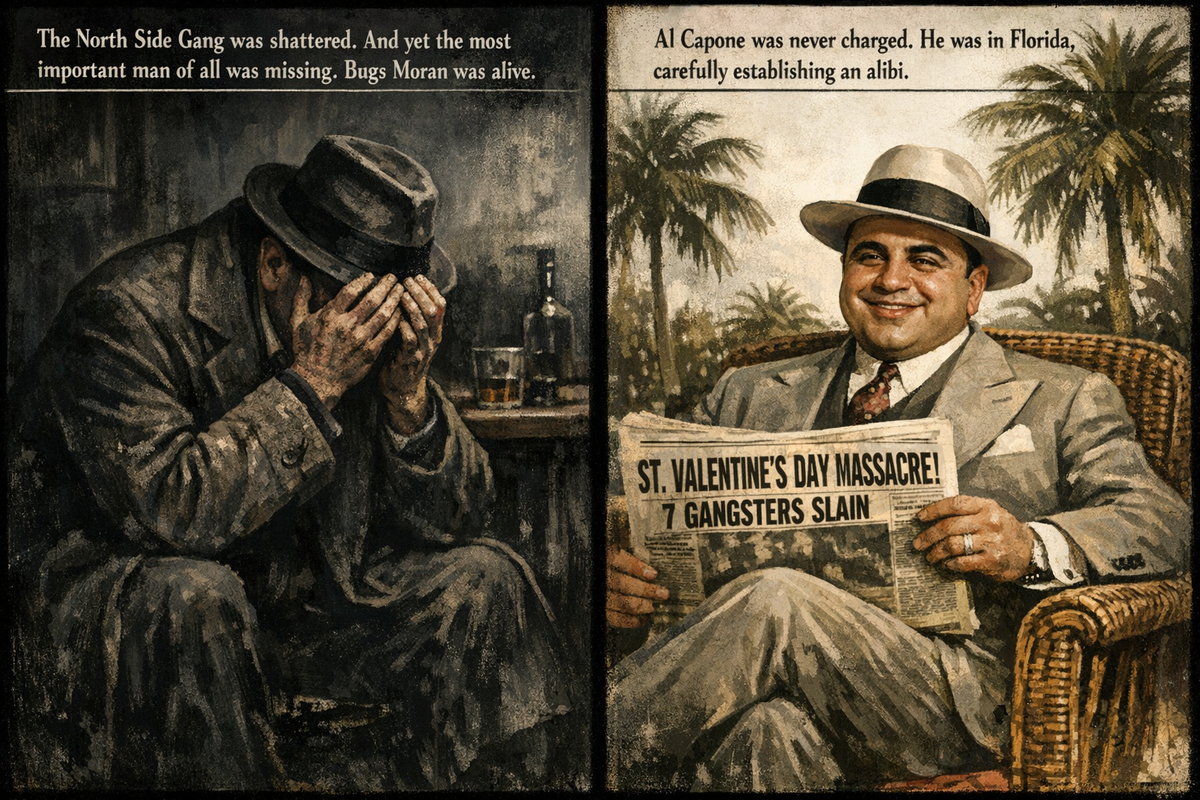
The North Side Gang was shattered—but the most important man was missing. Bugs Moran was alive. Al Capone was never charged. He had been in Florida at the time, carefully constructing an alibi. Everyone knew who had ordered the massacre, but no one could prove it. Public outrage, however, reached a breaking point. The government could not convict Capone for murder—but in 1931, they finally sent him to prison for tax evasion.
The St. Valentine’s Day Massacre did not end organized crime. But it destroyed the illusion that gangsters were glamorous. Seven men had been lined up like cattle and slaughtered in a garage. And Chicago—and America—would never forget it.