The Man Behind the Walls: Inside H.H. Holmes’ Murder Castle EP# 0002

Chicago loved to call itself the city of the future in 1893. Along the lakefront, the World’s Columbian Exposition rose like a dream made solid—white buildings glowing with electric light, reflecting off calm water, promising progress, beauty, and order. Millions walked those shining avenues, convinced they were witnessing a new age. They came to see what humanity could build when ambition and ingenuity worked hand in hand.
But a few miles away, in the neighborhood of Englewood, another vision of modernity stood quietly on a street corner. It was not white and luminous but dark, brick, and heavy. Gas lamps cast long shadows across its walls, and its windows absorbed light instead of reflecting it. This building did not celebrate the future. It consumed the present. Locals would later call it the Murder Castle.
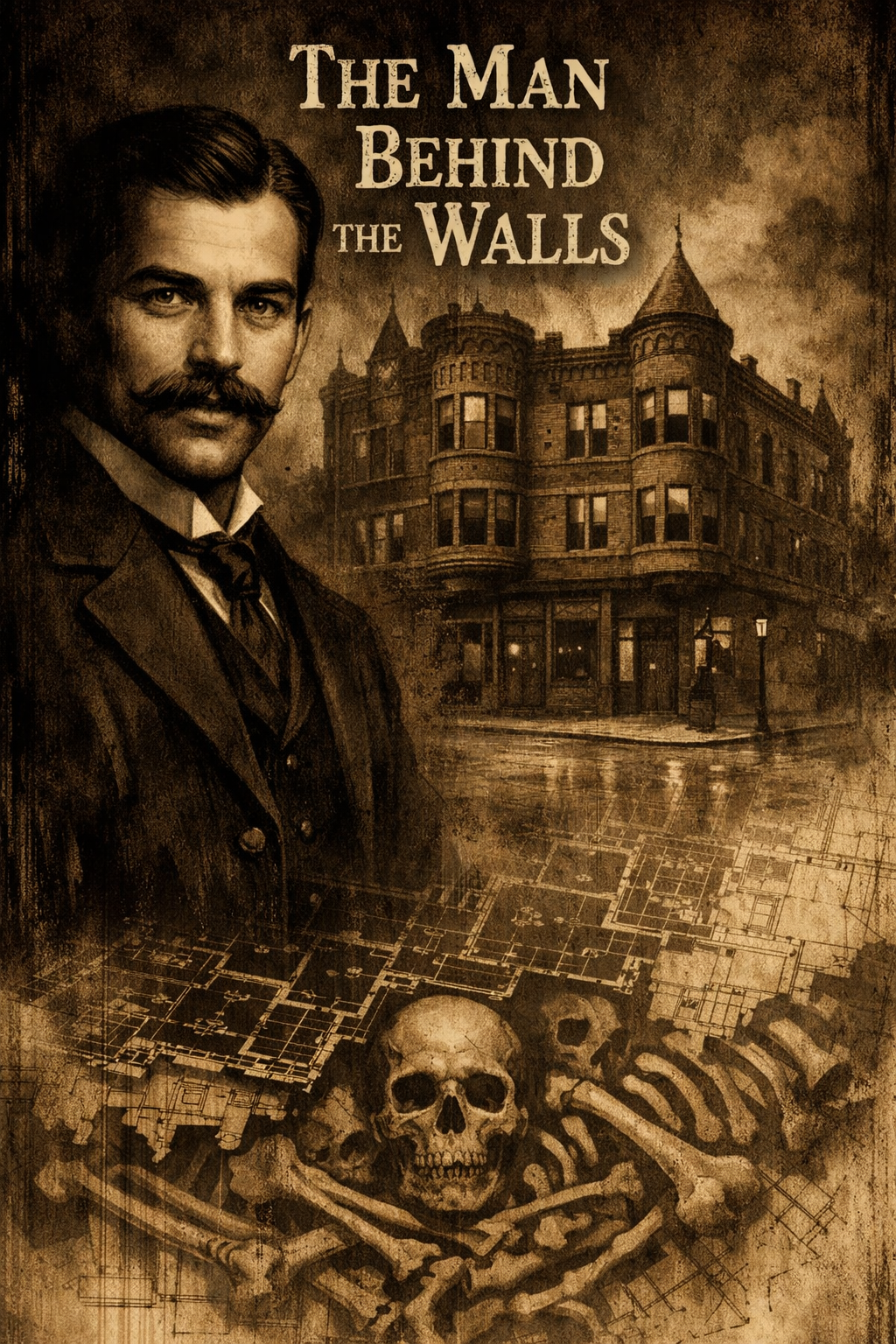
The man behind it called himself Dr. H. H. Holmes. He was handsome, articulate, and unfailingly polite—a man who seemed carved from trust itself. With his carefully groomed mustache, pressed suits, and calm voice, Holmes presented himself as a successful pharmacist and businessman. He shook hands gently, listened attentively, and smiled with reassurance. To the outside world, there was nothing monstrous about him at all.
Inside his pharmacy, glass bottles gleamed, and polished wood reflected warm light. Customers chatted easily while Holmes worked behind the counter, attentive and professional. To investors and neighbors, he was a model citizen. To young women seeking work, lodging, or affection in a fast-growing city, he seemed like safety personified. He offered opportunity in an unfamiliar world—and many followed him willingly through his doors.
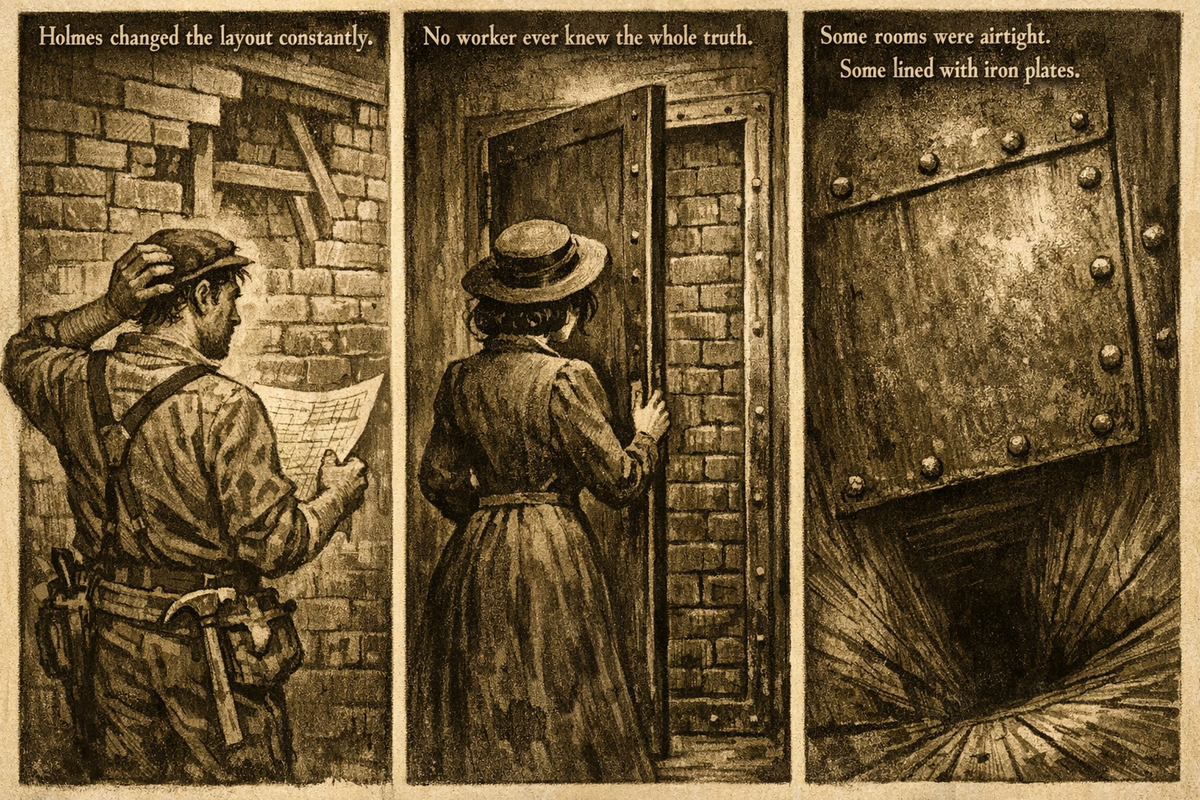
What none of them could see was the building itself. Holmes designed his hotel as a maze, constantly altering plans so no single worker ever understood the whole structure. Hallways turned without logic. Staircases ended at ceilings. Doors opened to blank brick walls. Some rooms were sealed shut from the outside, airtight and lined with iron. Others hid chutes that dropped straight into darkness below. Above it all, Holmes watched like an architect studying a model of human confusion.
Guests checked in, believing they were simply renting a room. Sometimes Holmes released gas into windowless chambers and waited, monitoring pressure gauges hidden in the walls. A needle drifting toward zero marked the quiet end of a life. Elsewhere in the building, locked doors muffled footsteps and fading voices. At night, Holmes moved through the halls like a shadow, listening, patient and precise.
Beneath the floors, the castle revealed its true purpose. In the basement, stone walls enclosed a grim laboratory outfitted with surgical tables and tools. Holmes worked there calmly, methodically stripping flesh from bone. He assembled skeletons with professional care, cleaning and polishing them until they were ready for sale. Medical schools paid good money, and even in death, his victims became a source of profit.
Greed, however, leaves traces. Holmes forged insurance claims, stole identities, and grew careless as his schemes multiplied. Detectives began to notice irregularities—papers that didn’t add up, disappearances that pointed back to Englewood. In 1894, the walls he built to protect himself finally failed. Holmes was arrested, irritated more than afraid, as if the idea of consequences were merely an inconvenience.
Two years later, the man who designed so many trapdoors stood on one himself. A hood was placed over his head, a noose tightened at his neck, and the platform fell away beneath his feet. His death was meant to be an ending—a clean break between the horror and the city that had unknowingly hosted it.
Yet endings rarely stay that simple. The Murder Castle eventually burned, flames tearing through its upper floors and reducing its secrets to ash. Still, locals whispered of footsteps in spaces, of doors creaking where no doors remained. In the dark ruins of the basement, some claimed to glimpse a familiar silhouette, watching and waiting, as if the man behind the walls was still there—quietly asking new guests to check in.