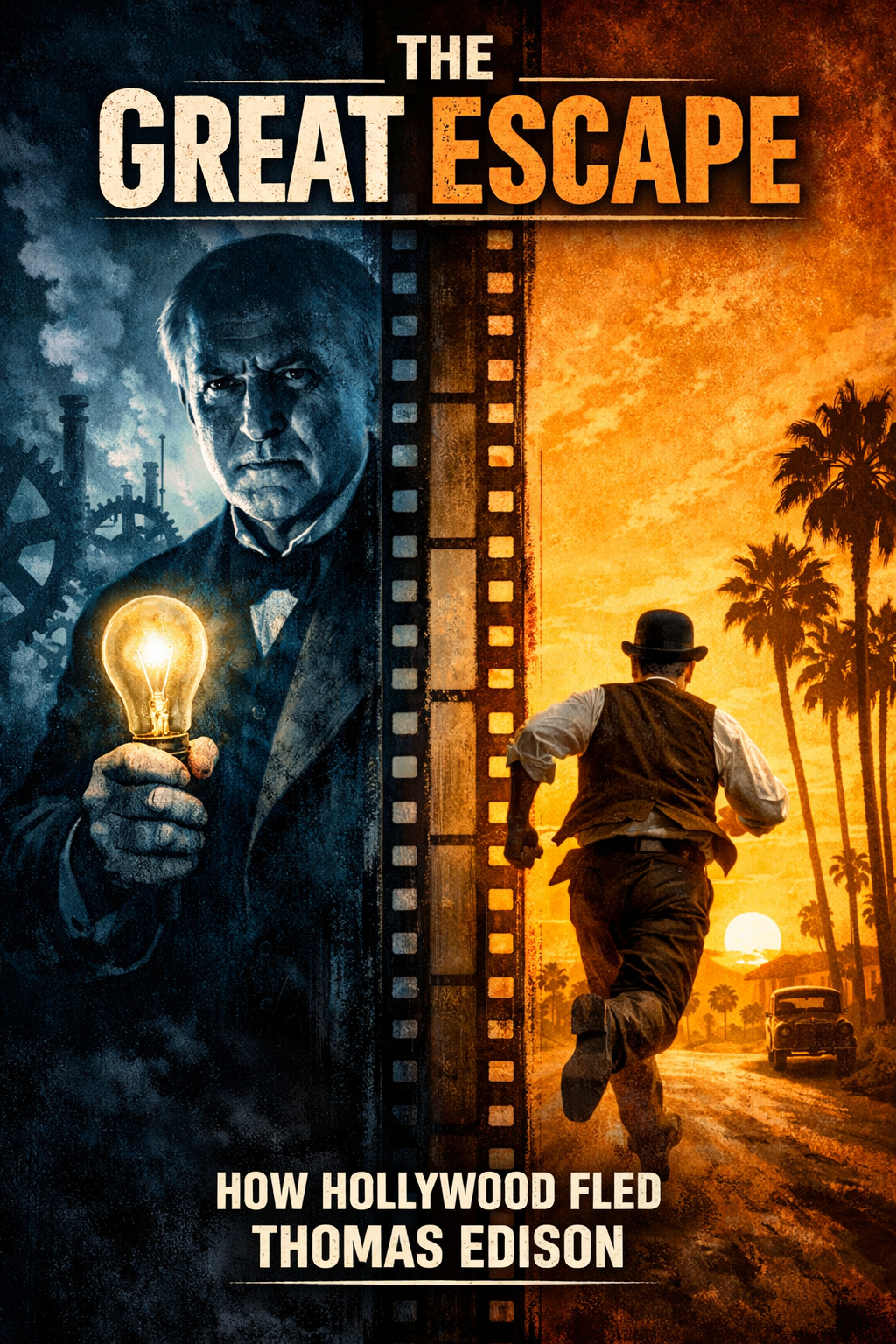
The Great Escape: How Hollywood Fled Thomas Edison EP# 0009

In the early 1900s, the American film industry did not live under palm trees.
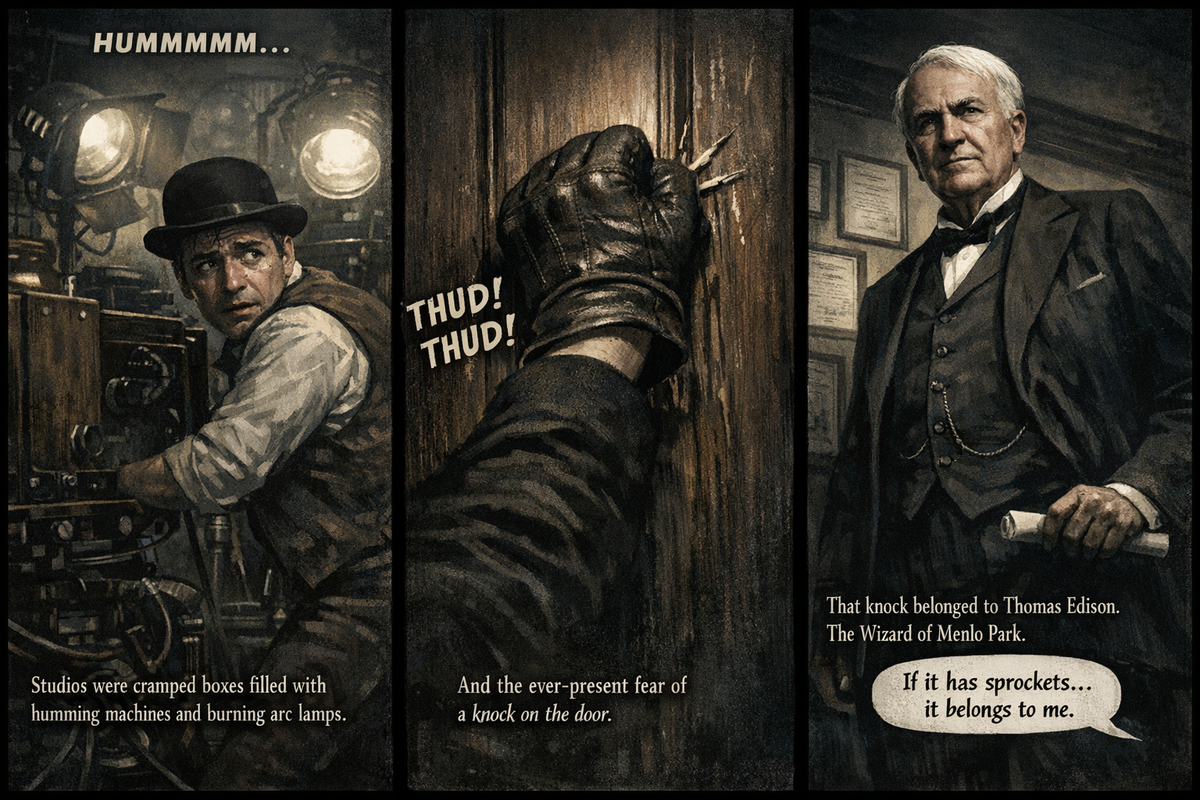
It lived in New York and New Jersey, inside cramped studios filled with humming machines, burning arc lamps, and the ever-present fear of a knock on the door.
That knock belonged to Thomas Edison.
By 1908, Edison was not just the Wizard of Menlo Park. He was the most powerful man in motion pictures. Through his company and the Motion Picture Patents Company, Edison controlled over 1,000 patents—covering cameras, film stock, projectors, and even the perforations along the edges of film. If you wanted to make a movie, you either paid Edison… or you became his enemy.
And Edison had enforcers.
They were called “the Trust.”
Private investigators and patent lawyers roamed New York and New Jersey, raiding independent studios, seizing cameras, shutting down productions, and dragging filmmakers into court. Small studios vanished overnight. Equipment was smashed. Film reels were confiscated. Careers were destroyed.
But the independents refused to die.
They began to run.
Some went west to Chicago.
Some went to Texas.
And some went as far away as they could while still staying in America.
They went to California.
Los Angeles, in 1910, was not Hollywood.
It was orange groves, dusty roads, oil fields, and endless sunlight. But it had three things Edison did not control:
Distance.
Weather.
And the courts.
California judges were not as friendly to Edison’s patent empire. Lawsuits dragged on. Enforcement was slow. By the time Edison's agents arrived, numerous productions had already concluded and departed.
Filmmakers could also do something impossible in New York:
They could shoot year-round.
No snowstorms.
No frozen equipment.
No dark winter skies.
Just sun. Every day.
By 1915, dozens of independent studios had planted themselves in the small town of Hollywood, turning it into a wild frontier of filmmaking. They built sets in cow pastures. They filmed chase scenes through real streets. They worked fast—because Edison’s men were still technically looking for them.
One director famously kept a train schedule on his wall, so if the patent agents arrived, he could grab his film reels and flee to Mexico by nightfall.
Then, in 1915, Edison’s grip finally broke.
The Supreme Court ruled that his Motion Picture Patents Company was an illegal monopoly. The Trust collapsed. The lawsuits stopped.
But by then, it was too late.
The movie industry was no longer in New York.
It was no longer in New Jersey.
It was in California.
Hollywood wasn’t built because it was glamorous.
Hollywood was built because it was far away from Thomas Edison.
And in that distance—between orange trees and desert skies—the modern film industry was born.